
This is paragraph text. Click it or hit the Manage Text button to change the font, color, size, format, and more. To set up site-wide paragraph and title styles, go to Site Theme.
October 2026 Newsletter

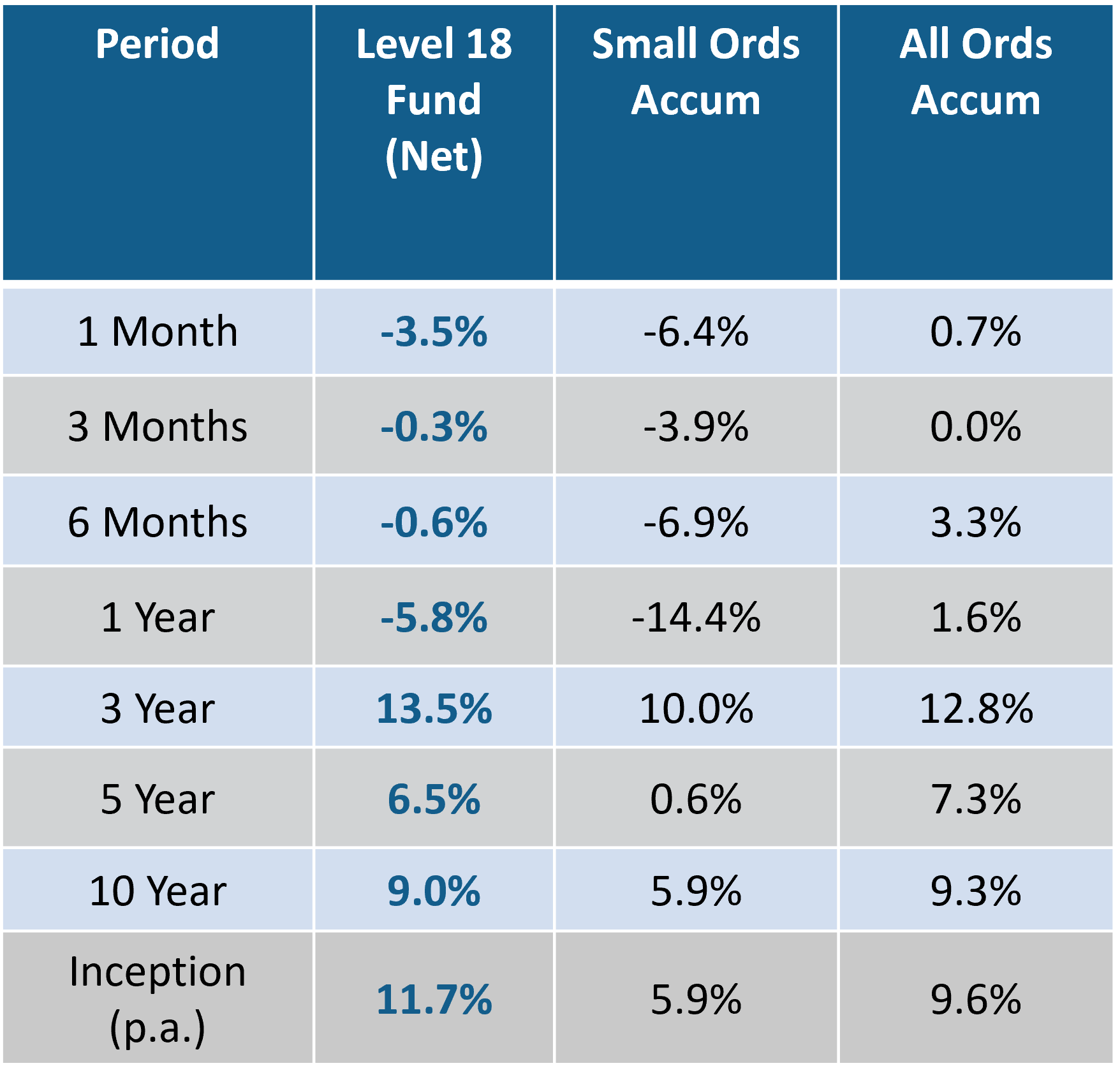
The Level 18 Fund decreased by -3.5 per cent net of fees for the month.
Commentary
The Level 18 Fund decreased by -3.5 per cent net of fees for the month.
In Australia, the All Ordinaries Accumulation Index increased by +0.7 per cent during the month as investors rotated capital out of risk assets into defensive exposures. Investors increased exposure to dividend-paying large caps with balance sheet strength and liquidity.
US equities underperformed the local market in October. Elevated inflation, rising US bond yields and a sell-off in AI-related stocks during the month impacted investor confidence and the market’s performance. In contrast to the previous month, US investors rotated out of semiconductors and AI infrastructure stocks.
The current US reporting season has been generally stronger than expected, although leadership remains highly concentrated in AI, technology, and financials, which continue to account for most of the market gains. The S&P 500 finished the month down -0.9 per cent and the Nasdaq Composite Index down -5.3 per cent.
The S&P/ASX Small Ordinaries Accumulation Index underperformed large caps for the month, down -6.4 per cent. During October, small cap industrials and small cap resources were down –2.9 per cent and -14.0 per cent respectively. A loss of investor confidence post the failure of the Firmus IPO and signs of financing stress for the planned AI build-out led to a sharp sell-off in AI-infrastructure exposed stocks and small cap growth stocks generally.
In Australia, Utilities were the best performing sector. Origin Energy (ORG) and AGL Energy (AGL) both moved higher as investors allocated to defensive stocks during the AI sell-off and wholesale energy prices moved higher. Consumer Services was a strong performer, driven primarily by Light & Wonder (LNW) and The Lottery Corp (TLC). Banks & Insurance also delivered a strong performance during the month.
Locally, inflation remained elevated. A higher than expected CPI result for the third quarter didn’t deliver the moderation the market expected. Importantly, it was also higher than the RBA’s forecast. As a result, the RBA elected to increase rates a fifth time this year to 4.85 per cent.
Interest rates are now at 18 year highs. Post the RBA board meeting, the bank removed its explicit tightening bias. Unlike the last increase, the decision was not unanimous. Six members supported a hike and three favoured leaving rates unchanged. The next RBA meeting is scheduled for mid-December.
In the US, The Federal Reserve did not change rates at its October meeting ahead of the US mid-term elections. The federal funds rate remains at a range of 3.75 to 4.00 per cent. Post the meeting, Federal Reserve Chair, Kevin Warsh, said “inflation has been running above the Committee's objective for close to six years. It's our responsibility to get inflation down.” The “hawkish” Fed position is unchanged.
Elevated bond yields and competition for credit between corporate and government debt markets dominated macro headlines during October. Long-term bond yields came off from 5.4 per cent to 4.9 per cent as investors started to question the capacity of debt markets to fund existing global government deficits and forecast AI infrastructure expenditure.
In Australia, investors decided the investment risks outweighed the rewards associated with the Firmus IPO. Valuation, debt funding, construction, execution, contracting and cash flow risks all contributed to the shortfall in demand for the stock. Post the withdrawal of the IPO, investors re-assessed the investment risks associated with contracted AI infrastructure construction projects. The potential for increased funding costs and construction delays delivered a rapid sell-down of engineering, construction, electrification and data-centre infrastructure stocks.
It is not usual for markets to move through periods of transition as investment preferences and risk profiles change. Given the short-term uncertainty associated with forecast AI infrastructure expenditure, elevated inflation risks and rising interest rates, we have elected to prioritise exposure to stocks with increased liquidity, market capitalisation and earnings visibility. The Fund continues to maintain an above-average cash weighting to preserve capital and to minimise volatility.
The Fund remained defensively positioned during October. However, as interest rates inevitably peak in the current cycle and investor risk appetite returns, the portfolio will reallocate capital back into growth sectors.
During the month portfolio holding Fleetpartners (FPR), entered into a binding Scheme Implementation Deed with SG Fleet/Pacific Equity Partners. SG Fleet will acquire 100 per cent of the shares in FleetPartners (FPR) for a cash consideration of $5.30 a share.
Positive contributors to the Fund’s performance in October include research, development and biopharmaceutical manufacturing group CSL (CSL), international bed & home furnishings company The Koala Company (KOA), general insurance & reinsurance group QBE Insurance Group (QBE) and exploration, mine site & drilling services company Mitchell Services (MSV).
Audio-visual & electrical contractor SKS Technologies (SKS), technology development group Codan (CDA) and engineering, electrical and telecommunications infrastructure product & services group Mayfield Group (MYG) made negative contributions to performance in the month.
Please contact Michael Carmody (mcarmody@centennialfunds.com.au or +61 414 952 985) if you would like any additional information regarding the fund.
The Level 18 Fund Information Memorandum (IM) is available on the Centennial Asset Management website. The following link (https://www.centennialfunds.com.au/) provides access to the IM.
The Centennial Team
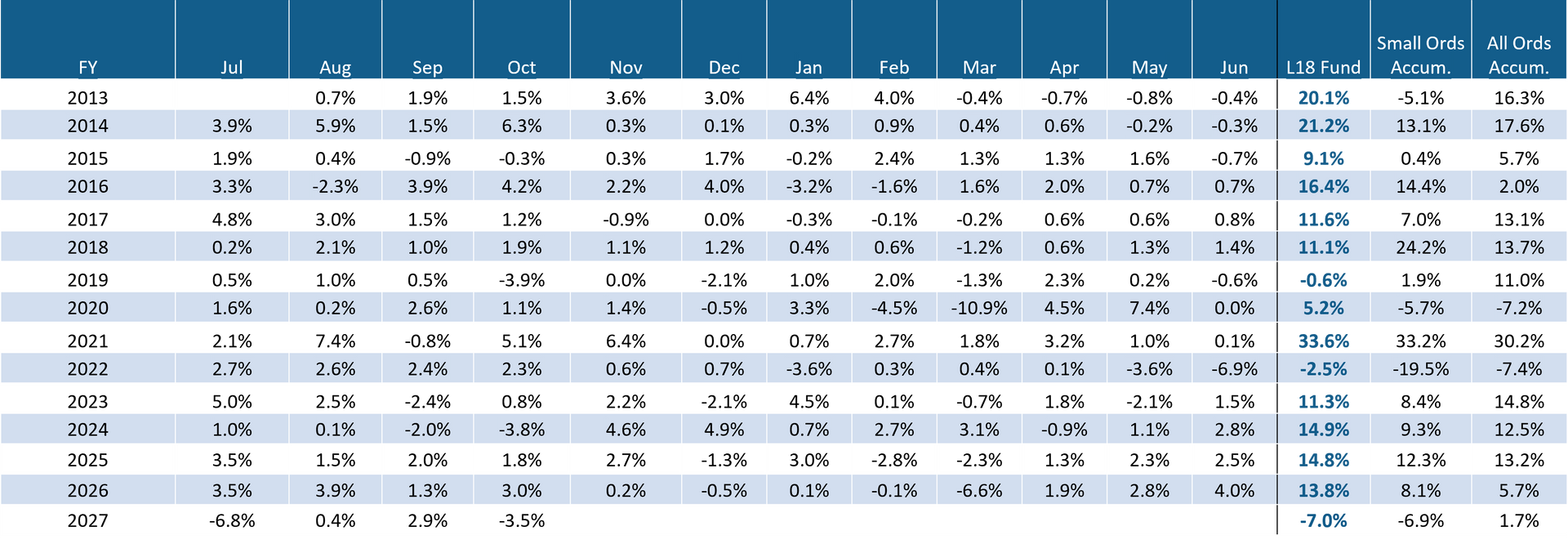
Monthly Net Returns Since Inception
About Centennial Asset Management
Centennial Asset Management is an independent Australian asset management business, and the manager of the Level 18 Fund, an index unaware fund, with asset allocation flexibility and a concentration of small capitalised companies. Further information on Centennial is available on our website - www.centennialfunds.com.au
Disclaimer
Strictly confidential: This report has been prepared by Centennial Asset Management ACN 605 827 745 & AFSL No. 515887 for Wholesale Clients only as an indicative record of the performance of an investment in the Level 18 Fund. No recommendation is made or advice given in respect of any entity in which the Level 18 Fund has, is or may in the future be, invested. The contents of this report are confidential, and the client may only disclose such contents to its officers, employees or advisers on a need to know basis, or with the prior written consent of Centennial Asset Management. Centennial Asset Management does not guarantee the performance of the Level 18 Fund or the return of any investor's capital in the Level 18 Fund. This investment report contains historical information, and does not imply any indication of future performance, recommendation or advice. Past performance is not a reliable indicator of future performance. Any investment needs to be made in accordance with and after reading any relevant offer document. This material has been prepared based on information believed to be accurate at the time of publication. Assumptions and estimates may have been made which may prove not to be accurate. Centennial Asset Management accepts no responsibility to correct any such inaccuracy. Subsequent changes in circumstances may occur at any time and may impact the accuracy of the information. To the full extent permitted by law, none of Centennial Asset Management, or any related body corporate or any officer or employee of any of them makes any warranty as to the accuracy or completeness of the information in this report and disclaims all liability that may arise due to any information contained in this newsletter being inaccurate, unreliable or incomplete. *Prior to launch of the Level 18 Fund on 1 September 2014, Centennial Asset Management had established a separately managed account (“SMA”) and performance prior to 1 September 2014 is illustrated on a gross pro-forma basis, that invests with the same mandate as the Level 18 Fund and is included in the tables above, for comparative purposes only. The returns assume reinvestment of distributions.